
AI Agent or Scripted Chatbot: What a Business Needs and What It Should Not Overpay For
Contents:
Contents:
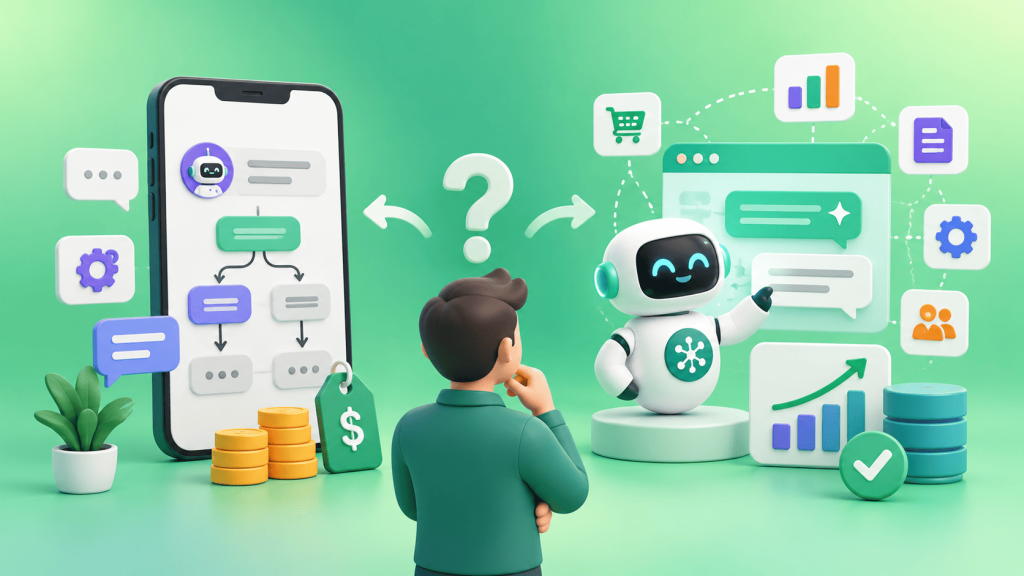
An AI agent sounds more complex than a regular chatbot, but that does not mean every company needs one. Often, a customer simply needs to check an order, book a service, leave contact details, or get an answer to a common question.
For these tasks, a scripted chatbot for business often covers the need without unnecessary complexity. AI makes sense when the conversation cannot be mapped in advance into a few clear steps.
What Is the Difference?
A scripted bot works according to rules defined during development:
- Order status.
- Order number.
- CRM request.
- Response to the customer.
The company knows in advance what the bot will ask and what action it will perform next.
An AI agent works differently. A customer may write: “I ordered headphones a few days ago. When will they arrive?” The agent needs to understand the request, clarify the details, and determine the next action. It works as a system that uses reasoning, planning, memory, and other connected tools.
When a Scripted Bot Is Enough
It is better to start with real customer inquiries. A scripted bot works well when you need to:
- accept requests and contact details;
- book a service;
- show order status;
- collect data before a conversation with a manager;
- answer common questions.
SMS Club develops chatbots for messengers and supports CRM integration. A bot can create a new request or retrieve an order status from the CRM.
If most conversations follow this logic, a separate AI agent may simply make the solution more expensive.
When an AI Agent Is Justified
AI becomes more useful when customers phrase requests in different ways and the answer depends on context. For example, one customer asks about product compatibility, another asks about returns, and a third describes a problem in detail. In this case, a scripted bot has to be constantly expanded.
An AI agent can work with free-form text, search for information in connected sources, and take previous messages into account.
Where AI Only Makes the Task More Complicated
Not every automation needs AI. If a customer needs to enter an order number, choose a date, or click “Book,” it is more important that the scenario works reliably and without extra steps.
AI will not add much value to this process, but it will add more work: you need to prepare data sources, define rules, test responses, and plan handoff to a manager.
The key question is whether the technology reduces the time needed to process the request and helps the customer get the result faster.
When a Manager Is Needed
Even a well-configured bot should not handle every situation. An unusual request, a complex consultation, or a question without enough data is better passed to a manager.
The bot can first collect the order number and briefly clarify the issue, then pass the prepared request forward. The manager will not have to start the conversation from scratch, and the customer will not have to repeat information they have already provided.
What You Should Not Overpay For
AI costs do not end with development. You need to configure data sources, access rights, operating rules, testing, and response control. Generative requests also have a separate cost. In Google Cloud, they are billed separately from deterministic scenarios.
That is why launching an AI agent for three simple actions does not make sense. If a customer clicks “Check order,” enters a number, and receives a status, a scripted bot can handle this without an additional layer of complexity.
When It Is Better to Combine Both Approaches
The best principle is this: everything that can be clearly described by rules should remain with the scripted bot, while AI should be used where understanding a free-form request is necessary.
For example, orders, payments, and bookings can work through buttons, while a non-standard question can be passed by the bot to AI or to a manager.
How to Understand What Is More Profitable
Before development, write down the 20–30 most common inquiries and see how many of them can be handled through a clear scenario.
Then calculate the result: how many conversations the bot completed without a manager, how many requests it passed to sales, and how much one processed conversation costs. Required actions on the website or in the app can be tracked as events in Google Analytics.
If a scripted bot covers most inquiries, that is enough. If managers are constantly getting involved because of non-standard questions, then there is a reason to consider an AI agent.
Frequently Asked Questions
How Is an AI Agent Different from a Scripted Chatbot?
A scripted bot guides the customer through predefined steps. An AI agent understands free-form requests, takes context into account, and can choose the next action on its own. For simple, repetitive tasks, this level of flexibility is not always necessary.
Can AI Be Added to an Existing Bot?
Yes, if the technical setup allows it. Standard operations can remain on buttons and rules, while AI can be connected only for non-standard requests. In other words, you do not have to rebuild the entire bot for one feature.
What Is Better to Choose for the First Launch?
If most inquiries fit into a few clear scenarios, it is more logical to start with them. AI should be added when the data shows that the bot regularly cannot handle requests without a manager’s involvement.