
How to Automate Sales Without Growing Your Team: Scenarios for Small and Mid-Sized Businesses
Contents:
Contents:
When the number of inquiries grows, the first reaction is often simple: we need another manager. But part of the workload does not come from complex negotiations. It comes from repetitive actions. Someone transfers a contact to the CRM, sends a confirmation, reminds a customer about an appointment, or answers the same questions again and again.
These stages should be automated before expanding the team. The goal of automation is to leave managers with the work that truly requires consultation, negotiation, and decision-making.
Start With the Lead Journey
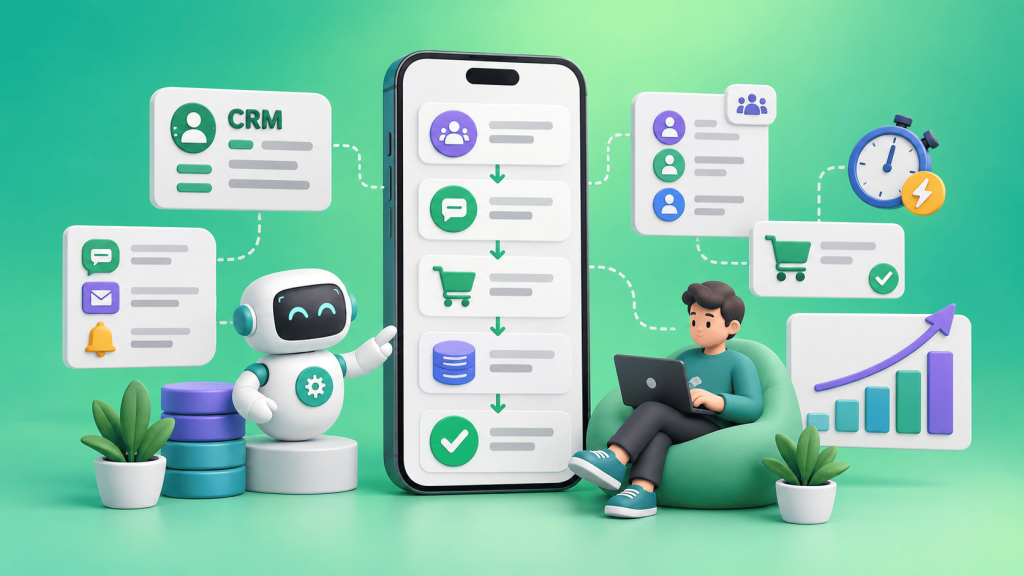
First, describe what happens after a customer contacts the company: website inquiry → CRM → manager → confirmation → call → payment → status notification.
If there is manual data copying between these stages, or if the process depends on a manager noticing a new record, this is where unnecessary work builds up.
It is better to use the CRM as the center of the process. Creating a lead or changing its status triggers the required action. SMS Club supports triggered campaigns after actions on the website or in the lead card, as well as integrations with CRM, CMS, and e-commerce platforms.
Scenario 1. An Inquiry Without Waiting
A customer leaves their contact details in the evening, when managers are already finishing their workday. Without automation, the inquiry will sit there until morning.
The system immediately creates a card, assigns a responsible manager, and sends a short message: the inquiry has been received, the team will contact them during business hours, and so on. In the morning, the manager sees a ready-to-process inquiry and does not waste time transferring data.
Scenario 2. Let the Bot Handle Common Questions
Managers answer the same questions every day: what is the price, is the product in stock, when will delivery happen, how to book an appointment, where to check the status.
This part of the conversation should be handed over to a chatbot. It collects data, shows the relevant section, or creates a lead. If the question goes beyond the script, the conversation is passed to a manager with context already included.
At SMS Club, the chatbot integrates with the CRM: it can receive the order status or add a new lead to the system.
Scenario 3. Event-Based Reminders
A manager does not need to remember who should be reminded tomorrow about payment, an appointment, or a reservation.
An event is defined: the lead status changed, the visit date is approaching, the order is ready, or payment has not been received yet. After that, the system automatically sends an SMS or Viber message. This is how triggered campaigns work.
It is important to include a stop condition. If the customer has already paid for the order, the reminder is no longer sent.
Scenario 4. Follow-Up Without Manual Control
A manager calls, but the customer does not answer. After that, the lead can easily get lost among other tasks.
After an unsuccessful call attempt, the CRM creates the next task, and the customer receives a message explaining who called and what the call was about. This way, the manager does not need to set a reminder manually, and the potential customer understands the reason for the call.
Scenario 5. Order Status Without a Manager
The question “Where is my order?” does not require separate work from a manager if the current status is already available in the CRM.
The customer enters the number in the chatbot, the system checks the data, and the status is shown. SMS Club supports this type of integration for chatbots.
What Should Stay With the Manager
Repetitive and predictable actions should be automated. Negotiations, complex selection, objection handling, and non-standard situations are better left to the manager.
A useful rule: if an action can be described as “when A happens — do B,” it is worth checking for automation. If context, agreement, or an individual decision is required, an employee should step in.
How Not to Over-Automate
You do not need to rebuild the entire sales process in one launch. It is more practical to start with one place where the team loses the most time: new inquiries, reminders, common questions, or order statuses.
Before launch, answer three questions: which manual action the scenario removes, what triggers it, and at what point the process is handed over to a manager.
How to Measure the Result
Before launch, record how much time the team spends on repetitive operations. After launch, compare lead processing speed, the number of manual actions, the share of unanswered inquiries, and the number of conversations the bot completed without a manager.
If the team handles more inquiries with the same staff, automation is doing its job. New managers should be hired when the amount of work that truly requires a manager grows, not when the number of routine operations increases.
FAQ
What should be automated first?
Start with creating leads in the CRM, confirming inquiries, sending reminders, and answering common questions. These are repetitive processes that most often take managers’ time.
Will a chatbot replace a manager?
No. A bot handles typical requests, data collection, and simple operations. Consultations, negotiations, and non-standard questions are better passed to a manager.
Is it necessary to change the CRM?
No. First, check the integrations and API of the system the company already uses. SMS Club supports ready-made CRM integrations and API-based connections.
How can you tell that automation is working?
Compare lead processing time, the number of manual actions, and unanswered inquiries before and after launch. If the team handles more leads without additional workload, the scenario is working.