
One Database—Multiple Countries: How to Set Up Multilingual SMS and Chatbots for International Business
Contents:
Contents:
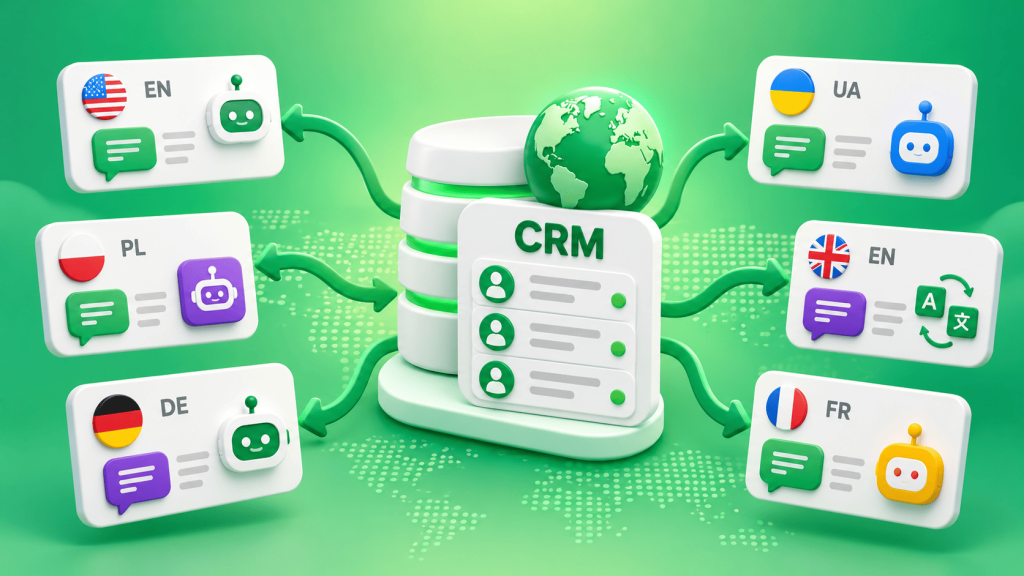
A company expands into multiple markets, but the customer database remains the same. In the CRM, phone numbers from Ukraine, Poland, Germany, and other countries are stored side by side. Some customers need messages in Ukrainian, while others need Polish or English.
At first glance, it may seem enough to translate one message into several languages. In practice, that is not enough. You need to correctly identify the customer’s language, use the right template, account for the phone number’s country, and avoid building a separate chaotic process for every market.
Do Not Split the Database Manually
Creating separate spreadsheets for “Poland,” “Ukraine,” and “Germany” is inconvenient. A better approach is to keep all customers in one CRM and add the necessary parameters to each customer record.
At a minimum, store:
- country;
- communication language;
- phone number in international format;
- time zone;
- messaging consent status.
The system can then choose the right workflow automatically. For example, a customer with PL as the language receives a Polish template, while a customer with UK receives a Ukrainian one.
Country and language should not be stored as a single field. A customer in Poland does not necessarily want to receive messages in Polish.
How to Determine the Customer’s Language
The most reliable option is to let the customer choose. The language can be selected during registration, checkout, or the first chatbot interaction and then saved in the CRM.
For chatbots, the messaging platform can handle part of the work. Viber provides the bot with the user’s country code and the language set in the app. Telegram also provides a language_code that can be used to adapt the bot interface to the user. In Telegram, this field is optional, so you need a fallback language in case the value is missing.
Automatic detection should still be treated as an initial assumption. If the customer manually selects a different language, that choice should take priority.
One Workflow Instead of Five Bots
You do not need to create a separate chatbot for every country.
The core logic remains the same:
product selection → contact information → order → confirmation → support.
What changes are the button labels, messages, prompts, and system responses.
For example, the customer’s language in the CRM is set to pl. The bot receives this parameter and loads the Polish text set. If the customer switches the language in the menu, the new choice is saved in the CRM and used during future interactions.
Telegram also supports localization of the bot name, description, and command list for different languages.
SMS Templates Also Need to Be Prepared Separately
Multilingual SMS has a technical detail that directly affects cost.
One SMS written in the Latin alphabet can contain up to 160 characters, while a message using Cyrillic can contain up to 70. Longer messages are split into multiple parts, and each part is billed separately. SMS Club also notes that a character outside the standard ASCII set can switch the message to a different encoding.
That means you should not simply translate an English version into Ukrainian and keep roughly the same length. After translation, each template should be checked separately for character count.
Pay special attention to personalization. A customer’s name, city, or order number increases the final message length.
Account for the Destination Country
International messaging is about more than translation. Pricing, sender ID rules, and route availability vary by country.
SMS Club supports international SMS and states that it operates across 158 countries. Message pricing depends on the destination, so costs should be calculated separately for each market.
As a result, the sending workflow should consider at least the phone number, country, language, and message type.
Do Not Translate Messages Word for Word
The same meaning does not require the same wording.
A Ukrainian phrase such as “Ваше замовлення вже прямує до вас” may sound unnatural when translated literally into another language. The same applies to greetings, dates, currencies, units of measurement, and button labels.
A better approach is to define the core meaning first and then adapt each language version separately. For transactional messages, pay close attention to variables such as the customer’s name, order number, amount, and date.
What About Time Zones?
A customer in Kyiv and a customer in Canada should not receive a promotional message at the same time based on Kyiv time.
Store the time zone in the customer record or determine it based on the selected market. Campaigns can then be sent at the appropriate local time for each segment.
Service messages follow a different rule. A verification code or payment confirmation should be sent immediately after the event, regardless of the time.
This keeps promotional and service messaging workflows separate.
How to Put Everything Into One System
The CRM should remain at the center of the setup. It stores the customer’s country, language, order history, and status.
When the required event occurs, the CRM sends the data to the messaging system:
customer → country → language → appropriate template → SMS or chatbot → result returned to the CRM.
SMS Club supports international SMS, messages in multiple languages, and API integrations. Data transferred through the API uses UTF-8, which is important when working with different alphabets.
With this setup, entering a new country does not require building the entire process from scratch. You add a new language set, market-specific rules, and the necessary templates, while the core workflow remains the same.
Frequently Asked Questions
Do you need a separate chatbot for each language?
No. One bot can work with multiple language sets and display the appropriate one based on the customer’s settings. It is important to save the selected language so customers do not have to choose it again during the next interaction.
Is it enough to determine the language from the phone number’s country?
No. The phone number’s country does not always match the customer’s preferred language. It is more reliable to store country and language separately and allow customers to change their language settings themselves.
Why can the same message cost differently in different languages?
SMS pricing depends on the number of message segments. A single segment can contain more characters in the Latin alphabet than in Cyrillic, so the message length should be checked again after translation.
What should you prepare before entering a new country?
Define the language, time zone, phone number format, message templates, and sending rules. Also check international pricing and sender requirements, then test the entire workflow on several phone numbers.