
How to Calculate the Real Revenue from SMS, Viber, and Chatbots When a Customer Goes Through Several Channels
Contents:
Contents:
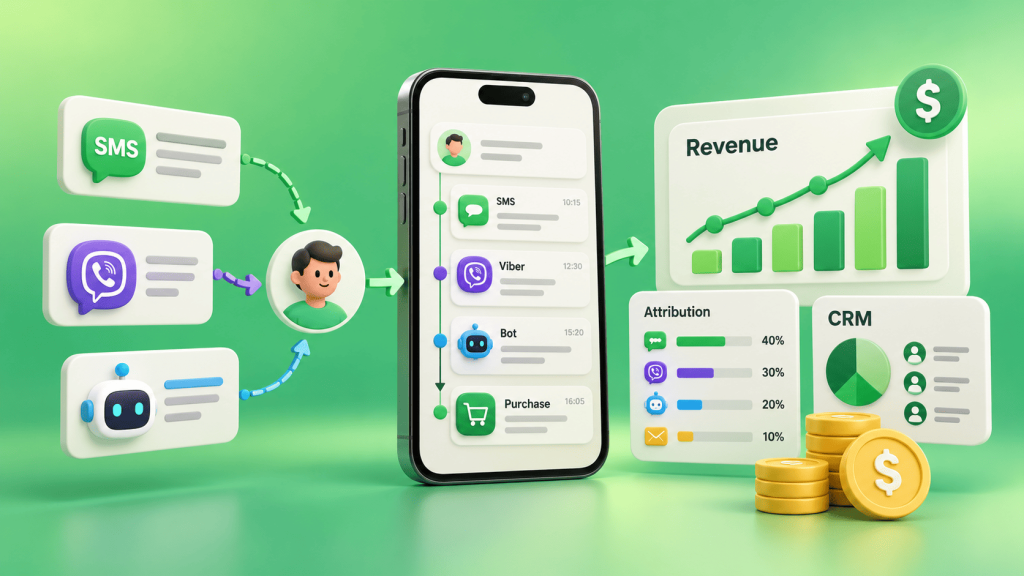
A customer does not always buy after the first message. Today, they may visit the website from an SMS. Tomorrow, they may read a reminder in Viber. A day later, they may open a chatbot and complete the order there.
If you only look at the last action, the chatbot gets all the revenue. At the same time, SMS and Viber may look useless in the report, even though they helped lead the customer to the purchase.
This approach is called omnichannel marketing: SMS, Viber, chatbots, and other channels do not work separately. They work as parts of one customer journey. That is why revenue should also be evaluated with all the touchpoints that happened before the purchase.
In Google Analytics, this is handled through attribution — the rules that determine how purchase value is distributed across different customer touchpoints.
Why the Last Click Does Not Show the Full Picture
Let’s take a simple example. A customer receives an SMS about a product and visits the website. They do not make a purchase. The next day, they open a Viber message. Later, they enter a chatbot, clarify the details, and place an order for about $67.
If the sale is credited to the last channel, the chatbot generated about $67, while SMS and Viber generated $0.
Mathematically, this is correct. But for evaluating the effectiveness of messaging campaigns, it is not entirely accurate. We do not know whether the customer would have opened the chatbot if they had not received the two previous messages.
That is why the full chain should be reconstructed first:
SMS → website → Viber → chatbot → purchase.
How to See the Customer Journey
Links in different campaigns should use UTM parameters. They help pass information about the source, campaign, and specific click to the analytics system. Google directly recommends tagging URLs this way to identify campaigns that drive traffic.
However, clicks alone are not enough. It is better to connect this data with a CRM or another system where leads and purchases are stored.
For example, a report should show not only that a person came from Viber, but also that they had received an SMS before that and made an order for a specific amount two days later.
For a chatbot, important actions can also be tracked: starting a conversation, selecting a product, submitting a request, or making a purchase. SMS Club supports API integration with CRM, CMS, and other systems, and also provides separate performance statistics for chatbots.
How to Distribute Revenue Across Channels
The simplest method is to assign the full amount to the last channel. Another option is to assign it to the first channel that started the customer journey. You can also split the amount across all touchpoints.
Let’s return to the order worth about $67. If SMS, Viber, and the chatbot all contributed to it, an equal distribution would credit each channel with about $22.
For more advanced analysis, there are models that evaluate the contribution of individual touchpoints based on accumulated data. For example, GA4 uses data-driven attribution by default: the value of a key action is distributed across touchpoints based on the role they played in the user journey.
The most important thing is not to find one “perfect” formula, but to use the same calculation method consistently. This makes it possible to compare the results of different campaigns properly.
Which Numbers Really Matter
The number of delivered messages, reads, and clicks is useful for evaluating the messaging campaign itself. For example, in SMS Club, Viber campaigns can track message delivery and reads.
But a read message does not automatically mean earned money. For the final evaluation, communication needs to be connected with leads, purchases, and their value.
In simple terms: channel revenue = total purchase value × the revenue share assigned to that channel.
For example, if Viber generated about $899 in attributed revenue during the month, and the messages cost about $112, these numbers can already be compared to evaluate payback. If you need to calculate profit rather than revenue, you will also need to account for cost of goods sold and other expenses.
How to Measure Cascade Messaging Campaigns
A separate case is when channels work sequentially. For example, a message is first sent through Viber, and if it is not delivered, the customer receives an SMS. SMS Club supports this format of cascade messaging campaigns.
In this case, the sale should not be credited to both Viber and SMS at the same time. You need to look at which message the person actually received and interacted with before the purchase.
How to Get an Objective Picture
SMS, Viber, and chatbots do not necessarily compete with each other. Often, they perform different tasks within the same journey: one channel brings attention back, another sends a reminder, and a third helps complete the purchase.
That is why a good report answers not only the question “where did the order come from?” but also shows which messages the customer received before the purchase, how much those touchpoints cost, and what revenue they helped generate.
Only after that can you decide which channel should be scaled, where the scenario needs to be changed, and which messaging campaigns are truly wasting money.
FAQ
Can you simply credit the sale to the last click?
Yes, if the path to purchase is short and the customer usually interacts with only one channel. But when SMS, Viber, and a chatbot were involved before the order, the last click shows only the final touchpoint and does not account for previous interactions.
How can you tell that a purchase is connected to a messaging campaign?
You need to combine data from different systems: tag links with UTM parameters, track clicks, and send leads and purchases to a CRM or analytics platform. This makes it possible to reconstruct the customer journey from message to payment.
Which attribution model is best?
There is no single option that works for everyone. For simple analysis, you can start with the last touchpoint or distribute revenue across channels. The key is to use one method consistently. Otherwise, it will be difficult to compare results across campaigns.
Is it enough to look at delivery and read rates?
No. These metrics help you understand whether messages reach the audience and attract attention. But to evaluate payback, they need to be connected with leads, purchases, the amount of generated revenue, and the cost of the campaign.