
Where Businesses Lose Paid Leads After Launching Ads: Auditing Communication from Lead to Sale
Contents:
Contents:
A typical situation: ads are launched, leads are coming in, the cost per lead looks acceptable, but sales are lower than expected. In this situation, advertising is often the first thing blamed: creatives, audiences, budgets, or even the contractor get changed.
However, the core problem may begin after advertising has already done its job. A person saw the ad, became interested, and left their contact information. From that point on, the result depends on what happens to the lead: how quickly someone sees it, who responds to the customer, and what happens if the customer does not answer the first call.
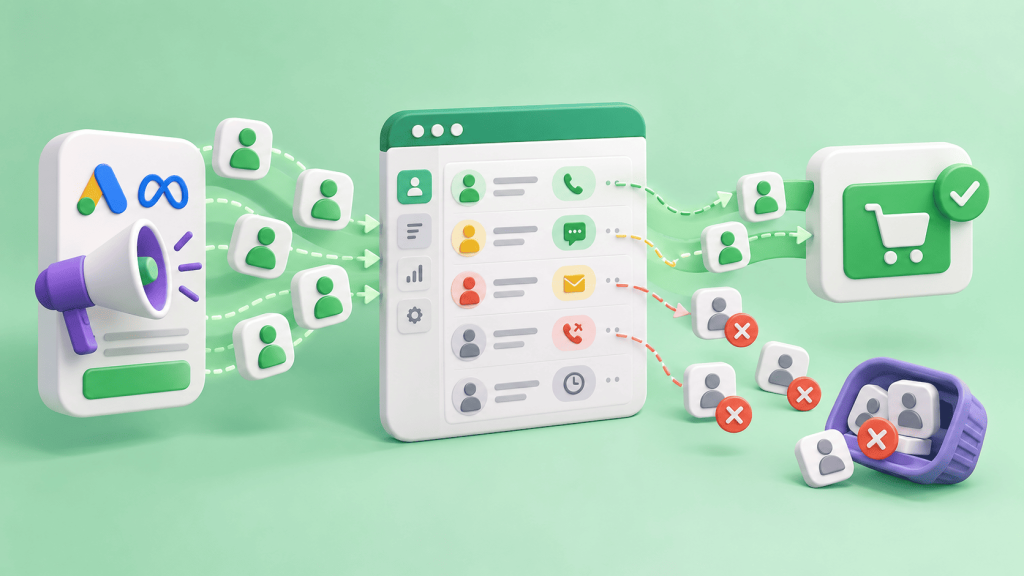
That is why it is important to evaluate the entire path: ad → lead → CRM → first contact → follow-up communication with customers → sale.
Loss №1: The Lead Was Seen Too Late
A person does not leave their phone number to speak with a manager tomorrow. At that moment, they have already shown interest, but that interest does not last forever. That is why it is best to respond to new inbound leads within the first few minutes. Automatic lead distribution, tasks, and manager notifications are used for this.
In practice, the weak point is often much simpler. The lead is already in the CRM, but the responsible manager has not opened it yet. Or it arrived in an inbox that is checked once every half hour.
During an audit, it is worth looking not at the average statement of “we respond quickly,” but at the specific time between lead creation and the first real attempt to contact the customer.
Loss №2: The Customer Does Not Understand That the Request Was Received
After submitting a form, the person sees a “Thank you” page — and then nothing happens. Ten minutes later, they may already have a simple question: will anyone actually call me?
This pause can be covered with an automated SMS or Viber message, such as: “We received your request. It has been sent to a manager, and they will contact you shortly.”
This message does not sell instead of the manager — it simply confirms that the request has been received.
In SMS Club, trigger messages can be sent automatically after a specific action on the website or a change in the lead card. The service also supports CRM integrations and CMS integrations through ready-made modules and an API.
Loss №3: One Failed Attempt Became the Last One
The manager called, the customer did not answer, and the CRM received a “no answer” status. If the work ends there, the company is effectively writing off part of its already paid leads after one attempt.
However, the potential customer may have been driving, in a meeting, or simply did not want to answer a call from an unfamiliar number.
This requires a clear next-step scenario: when to call back, whether to send a message, how many attempts to make, and at what point the lead can truly be closed. CRM automation makes it possible to create follow-up tasks, reminders, and lead handling rules so the process does not depend on the memory of a specific manager.
Loss №4: Advertising Counts the Lead, While the Company Counts the Sale
Another problem appears in reporting. The advertising system sees that the customer submitted a form and records a conversion. But it does not know what happened afterward: the manager could not reach the customer, the lead turned out to be unqualified, or the customer actually paid for the order.
Because of this, two campaigns with the same cost per lead can produce completely different results.
Google Ads allows businesses to send offline conversion data back to the platform, including qualified leads and sales. This way, advertising can be evaluated not only by the number of submitted forms, but also by what happened to those leads afterward.
How to Audit the Lead Journey
To start, it is enough to take the last 50–100 leads from paid advertising and manually review their journey.
Check when each lead came in, how many minutes passed before the first contact attempt, how many attempts were made, whether the customer received an SMS or Viber message, what final status is listed in the CRM, and whether there is a reason for refusal.
After that, the specific point of loss usually becomes visible. For example, advertising brought in 100 leads, but 20 of them received the first call only several hours later. Or 30 customers did not answer the first attempt, and no further contact was made. At that point, it becomes clear what exactly needs to be fixed.
How to Close Communication Gaps
Not every stage needs to be automated. But automatic lead confirmation, manager notifications, a follow-up SMS after a missed call, and reminders about unprocessed leads can all be launched without manual work.
SMS Club allows businesses to connect SMS and Viber to their CRM and use trigger-based scenarios. For example, a message can be sent after a lead is created or after its status changes. For selected CRMs, templates and message history are available directly in the customer card.
Advertising is responsible for bringing in an interested person. But a paid lead is not the same as a sale. If there are long pauses, missed leads, and no follow-up contact between the website form and the conversation with a manager, increasing the ad budget will simply bring more people into the same broken process.
FAQ
How can you tell if the problem is lead handling and not advertising?
Compare the number of leads with the next stages: how many received a timely response, how many were successfully connected with a manager, and how many ended in a sale. If leads are coming in but are being lost in large numbers after submission, communication is what needs to be checked.
What should you do if the customer does not answer the first call?
Do not close the lead immediately. You can schedule a follow-up call and send a short SMS or Viber message explaining who called and what the call was about. The key is to define one consistent scenario for all managers in advance.
Which metrics should be checked during an audit?
First of all, time to first contact, number of contact attempts, share of unanswered leads, reasons for refusal, and lead-to-sale conversion. These numbers show at which stage the company is losing people it has already paid to attract.
Can a sale in the CRM be connected to a specific ad?
Yes. The source of the lead should be stored in the CRM, and completed sales can be sent back to the advertising system as offline conversions. Google Ads supports this approach, including for qualified leads and later sales.